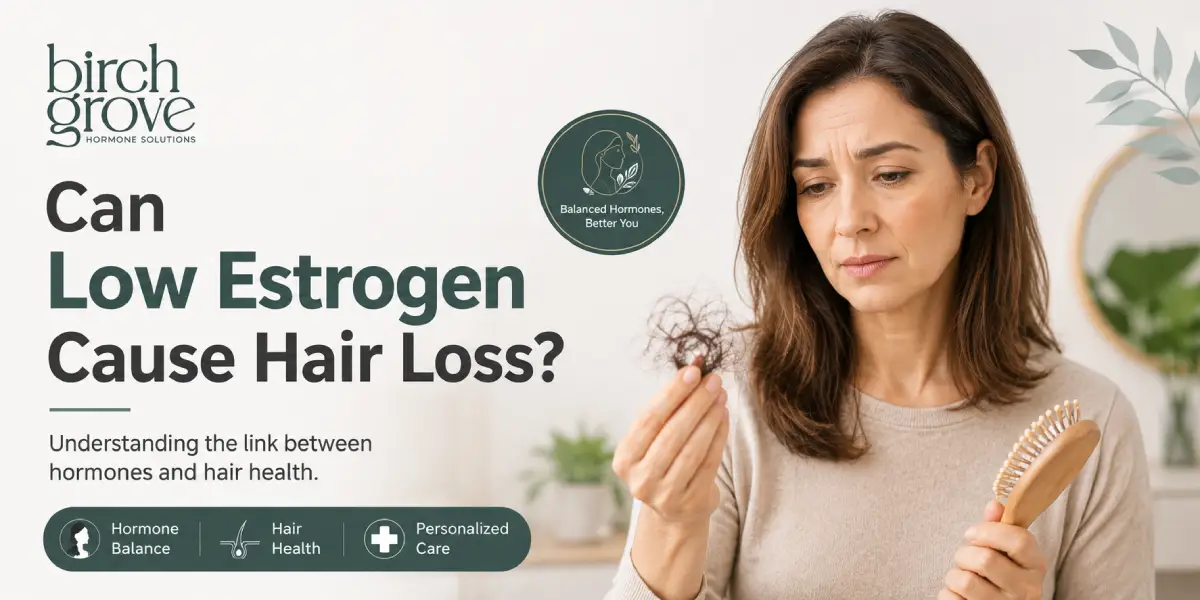
“Is my hair falling out because of my hormones, or am I imagining it?” I hear this question with some level of regularity, often from people who have already seen a dermatologist, already tried the specialty shampoos, already spent more time than they’d like searching for answers online. Does Low Estrogen Can Cause Hair Loss?Short answer: yes. And no, you’re not imagining it. Estrogen …

“Is my hair falling out because of my hormones, or am I imagining it?”
I hear this question with some level of regularity, often from people who have already seen a dermatologist, already tried the specialty shampoos, already spent more time than they’d like searching for answers online.
Does Low Estrogen Can Cause Hair Loss?
Short answer: yes. And no, you’re not imagining it.
Estrogen plays a measurable role in the hair growth cycle. When estrogen levels drop, hair loss becomes a common, legitimate symptom, not something to dismiss or chalk up to stress alone.
Hair grows in phases: a growth phase (anagen), a brief transition, and a resting phase (telogen), after which the strand sheds and a new one begins. Estrogen helps keep follicles in that growth phase longer.
This is why hair on a pregnant person often looks so full, as elevated estrogen levels keep more follicles actively growing. Then, a few months after delivery, estrogen levels drop sharply, and suddenly there’s hair everywhere… on the pillow, in the shower drain, wrapped around the vacuum brush. That postpartum shedding is essentially a preview of what can happen anytime estrogen falls significantly. Perimenopause, menopause, changes in hormonal birth control, thyroid shifts, or conditions like premature ovarian insufficiency can lead to estrogen level changes and symptoms such as changes to the hair growth cycle.
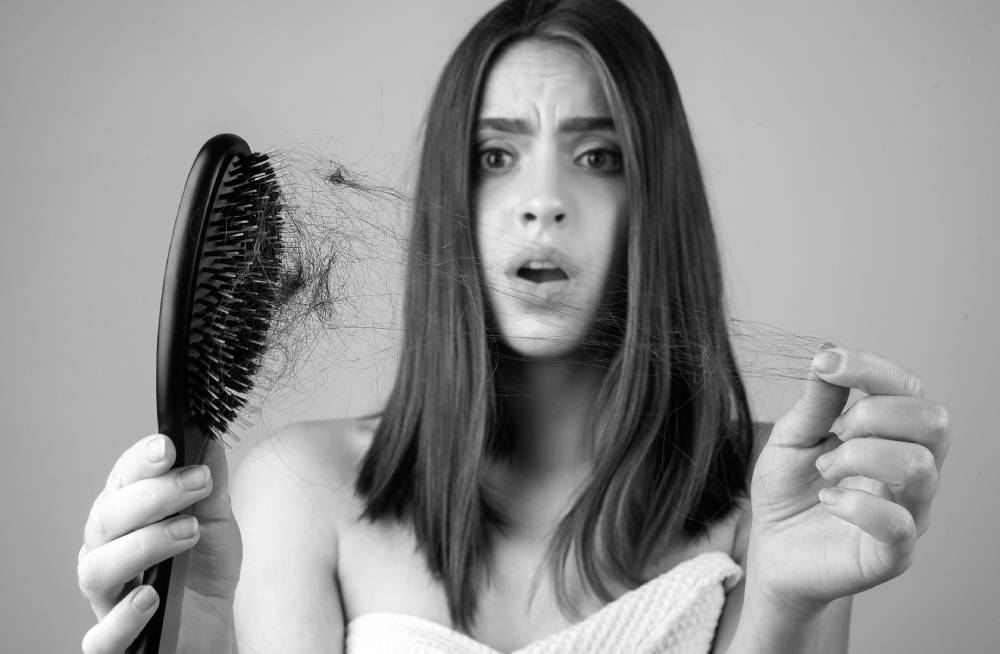
Hormonal hair loss will rarely show up as bald patches. It’s usually characterized by diffuse thinning, a wider part line, finer strands of hair, a subtle loss of density that adds up over time.
A Patient Story: Maren, Age 46
Let me tell you about a patient I’ll call Maren (not her real name), because her experience illustrates this perfectly.
Maren first came to me for anxiety and sleep issues. Hair wasn’t even on her radar. But after four months into our work together, almost offhandedly, she mentioned she’d started wearing her hair in a low bun because the thinning at her temples embarrassed her.
She had already seen two dermatologists. One prescribed a topical treatment. The other blamed stress. Neither asked her one key question: Where are you in your hormonal timeline?
Maren was 46. Her periods had become irregular. She was waking up warm at night without fully understanding why. Classic perimenopause, once you know the signs.
When we mapped her symptoms together, the pattern was obvious. Her sleep disruption, mood shifts, irregular cycles, and thinning hair weren’t four separate issues, but four expressions of the same underlying change: declining, fluctuating estrogen.
As a psychiatric nurse practitioner, I’m able to evaluate both the emotional and hormonal components of a case. Estradiol, FSH, thyroid function lab tests confirmed what I suspected clinically, Maren’s estrogen was dropping in a pattern consistent with perimenopause.
We discussed her options and started a low‑dose hormone therapy tailored to her history and risk factors. I monitored her closely and adjusted as needed.
A few months later, her shedding slowed significantly. Her hair regained much of its fullness. Her sleep improved. Her mood steadied. It made sense once we saw the full picture. Her symptoms were intertwined, and treating the root hormonal change, instead of chasing each individual complaint, is what truly moved the needle.
I share Maren’s story because it highlights that hormone‑related hair loss is a medical symptom. It deserves a full evaluation and a plan built around your actual physiology, not just a new conditioner and a guess.
Wait – Can High Estrogen Cause Hair Loss Too?
The answer isn’t a simple yes or no.
High estrogen alone typically supports fuller hair… again, think pregnancy. The issue arises when elevated estrogen is paired with elevated androgens (like testosterone) or increased sensitivity to those androgens. That combination can create thinning that resembles androgenic alopecia. Polycystic ovary syndrome is a good example: multiple hormones shift at once, and the interplay matters more than any single number.
Certain fertility treatments and hormonal medications can create similar ripple effects.
So the real question isn’t “Is estrogen high or low?” It’s “How is estrogen interacting with progesterone, androgens, and thyroid hormones?” That relationship determines what your hair actually does. Which is why guessing at home rarely leads anywhere productive, and why I always start with labs.
Also Read: Does High Testosterone Cause Hair Loss in Females?
How to Increase Estrogen for Hair Growth Responsibly
I want to be careful here, because the internet is full of “natural estrogen boosters” that sound appealing and aren’t backed by much. I’m not adding to that pile.
The most effective, evidence‑based path is medical. Here’s what that looks like in my practice:
We start with testing, not guessing
Order bloodwork: estradiol, FSH, LH, thyroid function, sometimes testosterone. Hair loss has many possible causes: iron deficiency, thyroid disorders, stress‑related shedding… and estrogen may only be part of the picture.
If low estrogen is confirmed, we discuss hormone therapy
Pills, patches, gels, and other options each carry different risk profiles depending on age, health history, and personal factors. I walk patients through these choices and build a plan around their specific labs.
We support treatment with habits that actually matter
- Adequate protein intake supports keratin structure.
- Managing chronic stress helps regulate cortisol, which interacts with estrogen.
- Consistent sleep supports hormonal balance.
- Regular movement and healthy body composition support long‑term hormone regulation.
None of these replace treatment. All of them reinforce it.
Also Read: Estrogen vs. Progesterone: How They Work Together (and Why Balance Matters)
We skip unregulated supplements
Many “natural estrogen boosters” contain phytoestrogens that can interact with hormone‑sensitive conditions. Taking them without medical guidance (especially alongside prescribed hormone therapy) can create more problems than they solve.
What I Hope You to Take From This
If you’re noticing more shedding or a widening part line, don’t dismiss it. And don’t rely solely on topical products.
Look at the whole picture. Where are you in your hormonal timeline? What else has shifted? These details matter, and they deserve real evaluation, real labs, and a plan tailored to your physiology.
Hormone‑related hair loss is common, explainable, and, as Maren’s story shows, treatable once someone connects the dots and addresses the underlying hormonal changes.
If you’re ready to understand what’s actually happening with your hormones, that’s exactly the work we do at Birch Grove Hormone Solution. Our Estrogen & Progesterone Balancing for Women treatment service is what you need if this is the case.